

A Beginner’s Guide to Hiking the Tour du Mont Blanc
Everything you need to know to hike the Alps’ Tour du Mont Blanc, including what to pack and when to go, plus TMB refuges, elevations, and typical days.
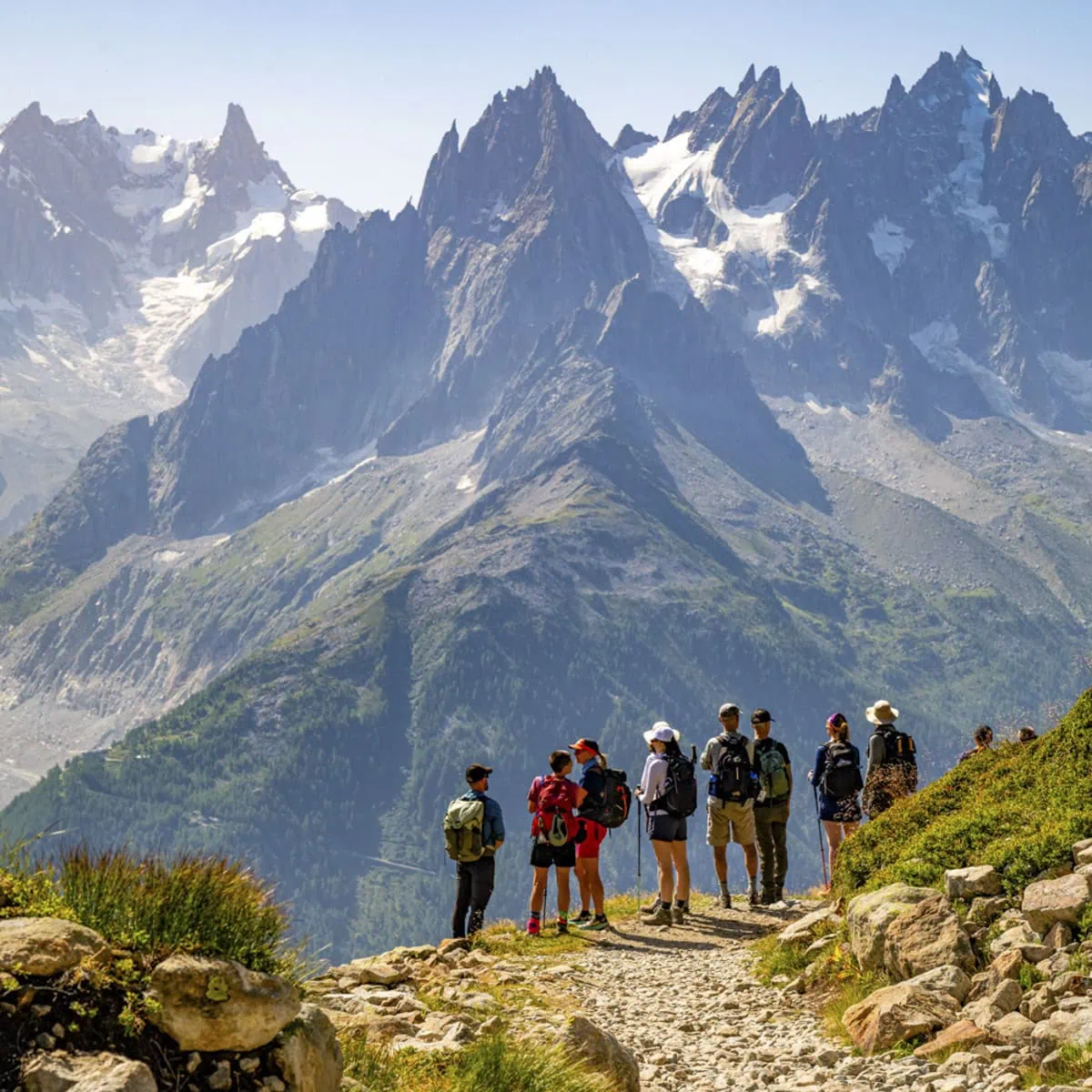
The Tour du Mont Blanc is one of the most popular long-distance walks in Europe. This magnificent trail is draped around the shoulders of the Mont Blanc massif, where the sport of alpinism was born in the mid-18th century and where some of the Earth’s most storied summits are found.
Ample accommodations, ski lifts, well-signposted and maintained trails, as well as fabled gear stores in the historic mountain towns en route mean that a lot of the nitty-gritty of trekking logistics is made easy here. So, you can focus on putting one sturdy boot in front of the other. The region’s bountiful natural splendor fills each day on the trail.
The TMB is a must-do for even the most traveled hiker, but also a rewarding progression for hikers who are ready to push themselves beyond local day hikes and take up the challenge of their first multi-day international hike. In this beginner’s guide to hiking the Tour du Mont Blanc, I will walk you through what to expect on this trip of a lifetime, and how to prepare.
Text by Killian Buckley, Europe Trip Leader
What is the Tour du Mont Blanc?
Frequently abbreviated to TMB, the Tour du Mont Blanc is a 105-mile long-distance trail in the Alps. It’s often considered one of the world’s greatest hikes.
The international trail circles the Mont Blanc massif and goes through the European Alps countries of France, Italy, and Switzerland. Hikers who walk the entire TMB typically do so in 10 or 11 days (since the trail is broken up into 11 stages), staying at mountain refuges that you can hike in and out from. The route passes through the breathtaking scenery of the Chamonix Valley, Italy’s Courmayeur, and the Swiss Val Ferret.
How difficult is the Tour du Mont Blanc?
Hiking the TMB is definitely a challenge. You need a good level of hiking fitness, you must be comfortable on uneven terrain at times, and you must be able to hike around 10 miles a day with up to 3,000 feet of elevation. But with a good pre-trip training regime, this adventure is within reach for most hikers.
The complete Tour du Mont Blanc covers 105 miles of mind-boggling trails, crosses 11 breathtaking passes beneath 18 of the Alps’ soaring 13,000-foot peaks, climbs through some 32,000 feet of elevation, and passes hanging glaciers along the way.
WT’s Mont Blanc hiking tour showcases the best of the TMB across a nine-day guided itinerary. It avoids the trail’s hardest sections, still showing you the region’s highlights. It cuts out the TMB’s uninspiring sections, leaving you with eight of the best mountain days you will ever have. And our Tour du Mont Blanc 12-day itinerary is more moderate, including two shorter hikes on the TMB along with hikes that capture the flavor of the region.
At WT, we pride ourselves in having the best guides in the world, and our alpine team has years of experience on this trail, adapting it to each group’s needs, setting a steady pace, and lending a helping hand when needed. Our Alpine FAQ blog covers the majority of questions we’ve had in our decades of running trips in the Alps. If you can’t find what you’re looking for there, contact our knowledgeable Area Specialists, and they will be there to help.
Below, you’ll find metrics for the difficulty of our TMB trip.
| Distance | Ascent | Descent | |
| Warm-Up Hike | 6 – 7 miles | 1,700 feet | 1,700 feet |
| Biggest Days | 10 – 11 miles | 2,600 – 4,400 feet | 3,200 feet |
| Average Day | 9 miles | 2,900 feet | 2,900 feet |


How to Prepare for the TMB
The most crucial element of a successful TMB takes place in the months before your boots hit an alpine path. Getting your body in shape should be your priority. After that, building mental fortitude and ensuring you have everything you need are essential to arriving in Chamonix relaxed and ready to complete a life-changing adventure.
Getting in Shape
Your most important piece of equipment for a successful trek around Mont Blanc is the one money can’t buy: your body. Rather than purchasing the latest featherlight poles or jacket, choose to spend time and effort on yourself! You’ll find a training plan suggestion below.
Your TMB Training Plan
Your first step should be aerobic fitness. Train with consistency. Hiking, biking, or jogging 2-3 times a week will help build the muscles of your heart as well as your legs, allowing you to keep going for the high pass when the going gets tough. Introduce a long hike once a week, starting three months before the trip, building gradually in distance and elevation with the aim of reaching the 11-mile, 4,000-foot goal in the weeks before your trip, equivalent to the TMB’s longest day.
Strength training, ideally once a week, particularly focusing on legs and core, can significantly enhance your general fitness and endurance, which you will appreciate as the glacial giants peer down from above. Then, a week out from the trip, pat yourself on the back and take the foot off the gas. Give yourself a rest, allow your body to recover, and once you hit the trail, you will be ready for whatever the trail throws at you.
Do I need climbing experience for TMB?
The Tour du Mont Blanc is a hiking route, which means that your feet will stay firmly planted on the trail throughout. Rock climbing or mountaineering experience is not necessary. Having said that, a TMB hiker should have plenty of experience hiking on variable terrain, covering considerable elevation gain and loss as well as distance before taking on the challenge.
Preparing Your Mind
Throughout your training, take note of your mental accomplishments, the times you pushed through despite being tired, and build an understanding of your mind’s ability to persevere is building mental strength. And a strong mind beats a long trail every time!
What to Pack for the TMB
A preliminary packing list for your trip should include comfortable hiking boots, a rain jacket and pants, base and mid layers, hiking poles, a daypack, two water bottles, and clothes to wear off the trail.
Knowing you have everything you need allows your mind to relax. A relaxed mind creates a calm body, and science tells us a relaxed body performs better and for longer during exercise. So, with that in mind, take a read through our Alpine what-to-pack blog and tick off our pre-departure kit list before you go.

An Average Day on the TMB
Despite each day on the TMB being uniquely spectacular, the geography of the Mont Blanc massif means there is a certain familiar rhythm to each day of the trek. Let’s run through the typical day on tour.
7:00 am
Breakfast
We stay at a variety of accommodations, from high-end hotels to trekking lodges. Each has its own charm, but no matter where we rest, every day starts with a good breakfast. Unfortunately for early risers, coffee is usually not available before the breakfast room opens around 7:00 am.
8:00 am
Bags Down
As the TMB is a loop hike, our luggage travels in the van with one of the guides each day. Bags should either be brought down to a meeting point or left outside your rooms by 8:00 am each morning, as instructed by your guides during the previous evening’s briefing.
8:30 am
Our Hike Begins
Depending on the day, we may take a short van transfer to the trailhead or walk right out of our accommodation into the wild. Apart from our first-day warm-up hike, each hike on the TMB has a similar terrain profile. As we stay in the valleys throughout our trek, our hikes generally begin with an ascent in the morning, rising towards our high point of the day, a high mountain pass, or col, as they are known locally. Along the way, our guides will select a few breathtaking spots to stop, catch our breath, rehydrate, and refuel.
12:00 pm
Lunch
Usually, we take our lunch at or just after our high point. In good weather, we will take approximately 30 minutes to eat and recuperate after our morning’s efforts. Sitting out on alpine meadows, having lunch, surrounded by the towering giants of mountaineering folklore, is an experience to be remembered.
On days when we carry our own lunch, your guides will either provide you with sandwiches bought from a local bakery or create one of WT’s famous build-your-own lunch spreads with a plethora of savory and snack options. Occasionally, we may visit a mountain refuge for a cooked lunch, a delicious pie, or a refreshing drink.
1:00 pm
The Descent
After lunch, it’s usually “all downhill from here.” However, don’t be fooled—the downhills are always a challenge! Zig-zags, steep sections, and rocky or rooty trail conditions after a considerable uphill effort mean that you will need to use the energy gained at lunch to overcome each day’s downhill challenges.
5:00 pm
Arrive at the Hotel
Except on days when we hike directly to our accommodation, you will take a short van transfer from the hike’s finish to the hotel. Your luggage will be in your rooms to meet you, and you will have some time to grab a drink or take a well-earned rest before dinner.
7:00 pm
Briefing & Dinner
Each evening, before we dine, our guides will brief the group on the details of the following day’s adventure. Then, in true Wilderness Travel style, we sit together for a fantastic evening meal in our hotel or in a local restaurant hand-selected by our world-class guides. You will have one night when you will eat dinner on your own in Courmayeur, and our guides recommend and book reservations at their favorite spots in the days leading up to it. Then, after dinner, it’s up to bed for a good night’s rest, before the Mont Blanc massif reveals its gems to us once again tomorrow.
When is the best time of year to hike the TMB?
The best time to hike the Tour du Mont Blanc is typically mid-June through mid-September. These months offer the mildest weather and the least chance of snow.
With the end of the ski season in early May, the valley inhabitants around the TMB dust off their hiking boots or trail runners and start hitting the lower altitude trails as the winter snow recedes. While it’s possible to hike the Alps in the lower areas as soon as winter ends, the high passes (up to 8,300 feet) have snow cover that makes access difficult until mid-June, when the Tour du Mont Blanc season opens in earnest and the first WT trips start. The TMB season runs through the summer until mid-September, when the lifts, restaurants, and hotels close shop for the autumn, and temperatures and weather conditions grow harsh at altitude.

Early Season
Mid-June to Early July
During TMB season, each month brings its own feel, color palette, and challenges. Between mid-June and early July, you’ll find quieter trails, free of snow at lower and middle altitudes (although your guide may provide microspikes for your boots if we cross any remaining snow patches in the highest, shaded sections). The alpine crocuses are the first wildflowers to appear, bursting out of the melting snows, and the snowpatch-mottled landscape of the surrounding mountainside is nothing short of breathtaking.
Benefits
- Quieter trails
- Cooler temperatures
- Stunning snow-speckled mountainsides
Challenges
- Possibility of snow on the passes
- More unstable weather outlook

High Season
July & August
By mid-July, all trails are snow-free, the hospitality network is fully operational, and the circuit becomes busy with beaming hikers arriving from all over the globe, ready for adventure. Throughout these months, wildflower blooms paint the mountainside in a complex palette of changing colors as temperatures rise. These are some of the best months to hike in the Alps.
The climate stabilizes during the summer, which means blue-sky days and views that extend far into the surrounding alpine ranges, as well as onto the towering glaciers of the Mont Blanc massif. Temperatures average 69°F, but high-pressure cycles can turn into heat waves, when temperatures can reach into the high 80s.
Benefits
- Fully operational trekking network
- Good weather is more likely
- Fantastic alpine flower blooms
Challenges
- Trails can be busy
- Possibility of heat waves

Late Season
Late August to Mid-September
With August’s end, the flowering season is over, and autumn is born. The larch trees begin to rust among the evergreen pines below the jagged aiguilles, and wild blueberries ripen by the thousands along the trail. The weather grows cooler, perfect for hiking, though the potential for rain during the day increases. With wetter weather, the mushrooms sprout among the pine forests. By the end of September, the alpine infrastructure is mainly closed, which means the TMB grows quiet for another season, save for a brave solo wild-camper.
Benefits
- Beautiful autumnal colors
- Cooler temperatures
- Quieter trails
Challenges
- Higher possibility of rain
- Some lifts, restaurants, etc. may be closed

What are the lodges and hotels like on the TMB?
The type of accommodations available on the Tour du Mont Blanc correlates directly to how remote we are on the journey. The more remote alpine lodgings are known as refuges (rifugios in Italy) and are a quintessential part of hiking in the Alps.
- In the large towns: In both Courmayeur and Chamonix, you can expect high-end hotels with spacious en-suite bedrooms and a variety of facilities from spas to chic lounges and well-stocked bars.
- In the smaller towns: In the smaller mountain villages of Contamines and Champex, we stay at warm, family-run, high-quality country lodges. Bedrooms will be en-suite, and we always aim to get the best rooms available.
- In the most remote areas: In the most remote part of the trek, in the valley of Chapieux and at the Col de la Forclaz, we stay at family-owned refuges, or trekking lodges. The facilities here, although historic, are more basic. You will have your own private room, but you may have to share a bathroom with your fellow trekkers. Chapieux, our most remote stay, is deep in a small valley surrounded by steep-sided peaks. So there is little, if any, WiFi available—perhaps an opportunity to engage in conversation and connect more deeply with the mountains around you.


What is the food like on the TMB?
Breakfast
Breakfast is served at our hotels and lodges each morning and is typically a hearty continental spread—fresh bread and pastries, cereal or muesli, fruit, yogurt, and coffee and tea—perfect fuel for the climb to the day’s high pass. In the larger towns like Chamonix and Courmayeur, you may also find a few extra hot options depending on the hotel.
Lunch
Throughout the trek, your guides will either provide you with sandwiches bought from a local bakery or create one of WT’s famous build-your-own lunch spreads with a plethora of savory and snack options. Whenever possible, you can enjoy local alpine delicacies such as rosti (Swiss potato pancakes) at a mountain refuge.
Dinner
It’s no secret that Wilderness Travel pulls out all the stops to ensure that guests enjoy great food to fuel our adventures. The TMB passes through France, Italy, and Switzerland, and you will find distinct flavors in each. Every night on the trek we enjoy a quality meal and local wines together at our accommodation. In the larger towns of Chamonix and Courmayeur, our guides will hand-select great restaurants that showcase the local cuisine.

Why should I hike the Tour du Mont Blanc with WT?
You’ll find benefits to both guided and solo trips of the TMB. A guided small group trip means all logistics are organized for you, so you don’t have to carry all your luggage on your back each day and you can expect good food and comfortable accommodations at day’s end. Our guided trips also show you only the best portions of the TMB, not the entire challenging trek, making it a slightly more accessible journey.
A solo trip, on the other hand, allows you to pace your journey however you’d like. It also means you can take part in the entire iconic Tour du Mont Blanc trek, hiked by over 10,000 hikers each year.
Expert Guidance
At Wilderness Travel, we know that nature’s trails are the foundation of our great Alps trips—but our guests often tell us our guides are the best they’ve traveled with. The men and women who guide with us have an ability to peel back the cultural, natural, and spiritual layers of this remarkable region, making them the real heart and soul of the TMB with Wilderness Travel.
Industry Leading Guide-to-Guest Ratios
Our journey operates with at least two fully qualified trekking guides on the trail each day. Our guides are trained mountain experts who keep their ears to the ground regarding the latest trail condition updates. This means you’ll be safe in the knowledge that they’re making the best choices each day as you adventure through this complex terrain.
Hand-Picked Dining & Refuges
We’ve been running TMB treks for decades and, in that time, have developed excellent relationships with local hoteliers and restaurateurs. In addition, our guides are always looking for great new places to stay and eat, ensuring that we always have a great combination of the traditional and the fresh.
High Trails, Lasting Connections
Our guests, guides, and service providers on the TMB come from all walks of life. Traveling as part of a WT group, you’ll find that the people you travel with share much in common, including a love of nature. From that starting point, we’ve seen friendships that began on an alpine pass on the TMB become treasured bonds lasting decades.
Frequently Asked Questions
Chamonix, the starting point for our TMB, is a 1-hour drive along the Autoroute Blanche from Geneva Airport. So most of our guests will fly into Geneva at the start of the trip. Our office will arrange a van transfer to the Chamonix hotel where our trip begins, and a return transfer to Geneva Airport.
A beginner hiker can complete the Tour du Mont Blanc, but only with a high level of fitness. Some prior hiking experience is necessary, along with the ability to complete long stretches of cardio. But while the TMB trails are often steep and long, they don’t require a great deal of technical savvy. As long as you’ve adequately prepared with a fitness regimen and proper packing, a novice hiker should be fine on WT’s TMB trip.
While you needn’t be a marathon runner, you’ll want a good level of fitness to hike the TMB. You should be able to hike or walk on hilly terrain for at least five or six hours at a time. Jogging, using the gym’s stair climbing machine, and light weight training, especially of the core and legs, are all great ways to prepare for hiking the TMB.
The Tour du Mont Blanc is not highly technical compared to other challenging hikes. While many trails are reasonably wide and well-trodden, some sections do require some technical savvy with a bit of scrambling over exposed rocky terrain.

Still Have Questions?
Our Alps Specialists are here to help you choose the perfect departure, prepare for your journey, and feel fully confident every step of the way. Contact us to get personalized recommendations and insider guidance.


