


BOOKING DISCOUNT
20% off all cabins for July 5, 2027 departure
10% off off all cabins for July 15, 2027 departure
Valid on new bookings, offer expires Oct 30, 2026
The Kimberley, considered Australia's last frontier, is a vast land of remote, sublime scenery outlined by rugged coastlines and crystal clear waters of the Timor Sea and the Indian Ocean. Palm-fringed gorges, desolate mountains, and Aboriginal rock paintings are the setting of this 10-day cruise that takes you from Darwin to Broome. Along with expert guides, retrace the history of Phillip Parker King who first charted these waters almost 200 years ago, interpret 40,000-year-old rock art, and feel the spray from the magnificent King George River and its towering falls. Explore by Zodiac and watch for crocodiles, tawny nurse sharks, sea turtles, whales, and rock wallabies. Cap off your days with drinks on the beach or on board your ship while admiring the ochre-colored sandstone cliffs in this wild and ancient land.


Arrive: Darwin, Australia (or reverse)
Depart: Broome, Australia (or reverse)



Note: This trip is not exclusive to, nor operated by, Wilderness Travel, who acts solely as an agent in booking your reservation with the operator. Please download the Rate Sheet in the Dates & Pricing section to see the full pricing details and contact our Cruise Collection Specialists to check availability.
Join Heritage Adventurer this afternoon at Darwin Port, Australia’s northern gateway, famous for its glittering harbor, World War II history, and enviable tropical lifestyle. The captain and expedition team will greet you on
arrival and show you to your cabin. You will have time to settle in and familiarize yourself with the ship; you will also be introduced to you to your expedition team and the voyage plans. You are invited to join the expedition team in the Observation Lounge and up on the Observation Deck as the ship sets sail for the Kimberley. Note: some voyages operate in reverse.
The approach to King George River gorge is not to be missed and best experienced out on the Observation Deck as the towering 2,000-million-year-old Warton sandstone cliffs dwarf the vessel. Navigating this scenic stretch of water by Zodiac, there’s much to take in passing the ever-changing eroded rock faces as we cruise deeper into the gorge marveling at the untouched beauty of this iconic waterway. Reaching the end of the gorge, nothing will prepare you for the grand-scale spectacle of the Kimberley’s highest single drop falls as the King George River plummets 262 feet over the edge of towering ancient red sandstone cliffs into tidal waters. Undoubtedly, one of Australia’s most awe-inspiring natural wonders, the twin falls, known as male and female Rainbow Serpents, or Wunkurr by the Balanggarra people, are fed by wet season rains and rightly hold a special place in indigenous lore. While here you will learn about how this natural wonder was created and enjoy a closer look.
Beautiful islands, pristine white beaches lapped by turquoise waters, secluded coves, and stunning scenery abound in Vansittart Bay, which is also the location of a historical World War II site and incredible ancient Aboriginal rock art. Named after the Chancellor of Exchequer by early explorer Rear Admiral Philip Parker King, this striking, naturally protected bay is framed by scattered jagged sandstone monoliths and the final resting place of the preserved skeleton of a WWII Douglas DC-3 Aircraft that crash landed onto the saltpan after running out of fuel during a mercy mission to evacuate four Dutch citizens from Java. On Jar Island, ancient outdoor Aboriginal Gwion Gwion art galleries are set among fascinating caves and rock formations. Much of the rock art tucked under ledges and featured on cave walls is estimated to be up to 40,000 years old and is remarkably preserved, protected from the elements. The island is also home to some interesting flora and fauna including the golden-backed tree rat, echidnas, and birdlife. Discover a bounty of anthropological and historical wonders in Vansittart Bay.
Closer to Indonesia than mainland Australia, Ashmore Reef is Australia's most remote marine park. Its three tropical islands are surrounded by coral reefs and are home to more than 500 fish species, 225 reef building coral species, and 100,000 nesting sea birds. A designated important bird area (IBA) and mostly Sanctuary Zoned, access to Ashmore Reef is strictly controlled. Our visit complies with Australian Government regulations; however, there may be an opportunity for a Zodiac cruise near West Island.
Today you'll explore the sites of ancient Aboriginal rock art on Bigge Island and the historic Mermaid Boab Tree, which bears the name of the HMC Mermaid that was famously carved into it while the ship was beached there undergoing emergency repairs during Philip Parker King's third voyage of discovery of the region in 1820. Now measuring some 10 feet wide and National Heritage listed, the tree offers a glimpse into Australian colonial history, while an old Makassan Islamic prayer alcove can be found behind the tree. Here, you will also explore the jaw-slackening, otherworldly sandstone coastline of York Sound with its incredible sea caves and fascinating wildlife.
Today the ship navigates the scattered islands, known as the Bonaparte Archipelago, which stretches almost 95 miles along the dramatic coastline. Our destination today is the remote and unspoiled inlet of T-shaped Swift Bay with its sandy beaches, ominous sea-worn caves, and mangroves. A Zodiac cruise here allows a closer look at this incredible coastline where you will also likely observe salt-water crocodiles. On land, several rock art galleries display the unique Wandjina and Gwion Gwion styles on a large scale, denoting the region's cultural importance.
During explorations of the Hunter River today it will quickly become apparent why this winding, 18-mile stretch of water is widely considered to be one of the highlights of the Kimberley Coast. Tucked into the northeast corner of Prince Frederick Harbour, an enormous bay that puts Kimberley's epic scale into perspective, this scenic wonderland is dotted with islands and flanked with wildlife-filled, mangrove-lined rivers, savanna woodlands, soaring red cliffs, and patches of lush monsoon rainforest, courtesy of receiving the lion's share of the region's rainfall. At the river's mouth, the unrestrained grandeur of 650-foot-high sandstone escarpment Kampamantiya keeps silent sentry, welcoming you into this otherworldly realm that you will be exploring today. Fed by two 300-foot waterfalls, the Hunter and the Donkin, Hunter River is home to one of the largest and most pristine mangrove systems in the world. Zodiac cruising the coastline could see us spotting diverse wildlife including whitebellied sea eagles, osprey, great-billed heron, eastern reef egret, red-headed honeyeater, blue-spotted mudskippers, fiddler crabs, and more. While here you will also explore Naturaliste Island/Wunumpurramarra and its remarkable, 100-foot-long beach strewn with marine snail shells. There is also the opportunity to experience the grandeur of the iconic Mitchell Falls on a thrilling scenic heli-flight (optional extra). This is the only way to experience Kimberley's famous four-tiered falls and includes a landing on the stunning Mitchell Plateau, one of the most scenic and biologically important areas in Australia. Here you will explore this incredible sandstone landscape carved by the Mitchell River.
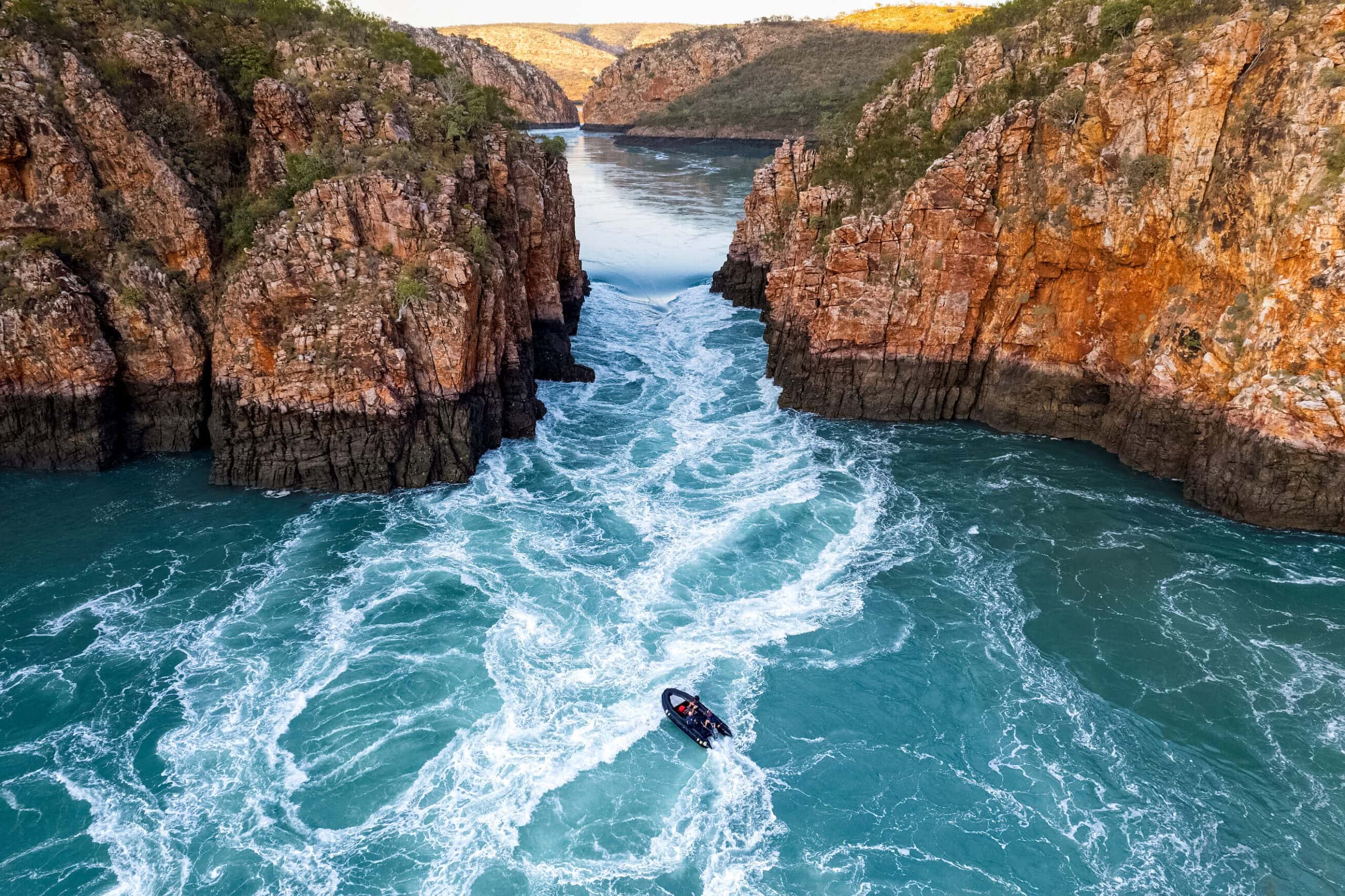
Located at the eastern end of the Buccaneer Archipelago, and only accessible by sea, you have two days to explore the ancient land- and seascapes of Collier Bay and its astounding natural attractions. At Talbot Bay, experience the power of the region's massive tidal movements that have shaped the landscape, most famously at the world's only Horizontal Falls. Here you will witness what David Attenborough described as “one of the greatest wonders of the natural world” as trapped water in an inland bay thunders between two narrow chasms, as the tide drops more than 45 feet on the other side, creating spectacular falls, whirlpools, and boiling whitewater. At nearby Cyclone Creek, explore the twisted geological folds of the ancient seabed and hope to see inquisitive tawny nurse sharks among the incredible marine life on display, while another tidal spectacle awaits at Montgomery Reef at the bay's center. We hope to capture the magic of observing this enormous reef “rise” from the ocean as the tide falls create torrents and waterfalls up to 10 feet high and displace marine life, igniting a feeding frenzy as predators above and below the water descend. At Freshwater Cove, shoreline explorations of the caves and grottos reveal a multitude of ancient rock art galleries.
Today we explore the incredible wildlife reserve and birding paradise of the Lacepede Islands. Designated a nature reserve in 1970 and rat free since 1986, this collection of four unassuming islands off the northwest coast of Western Australia are recognized as an Important Bird Area by BirdLife International with what is thought to be the largest breeding colony of brown boobies, up to 18,000 pairs, in the world. These small, low-lying spits of coarse sand and coral rubble atop a platform reef are also the state's most important breeding grounds for green turtles. Other wildlife that calls these remarkable islands home include roseate terns, masked boobies, Australian pelicans, bridled, greater and lesser crested terns, eastern reef egrets, lesser frigatebirds, and pied and sooty oystercatchers, while grey-tailed tattlers, whimbrels, bar-tailed godwits, ruddy turnstones, and great knots are among the visiting vagrant species. While landings are not permitted, we plan to explore the island's incredible shores by Zodiac and, if lucky, we may see some humpback whales that frequent this coastline during their northern migration in winter and early spring.
This morning, arrive in Broome, a former wild frontier now a relaxed tropical beach resort and gateway to the Kimberley. After breakfast, there will be a complimentary coach to a central hotel or Broome International Airport. To allow time for disembarkation procedures and travel from Broome, we do not recommend booking flights departing before 1:00 pm.
Day 1: Broome
Day 2: Lacepede Islands
Day 3-4: Collier Bay
Day 5: Hunter River
Day 6: Swift Bay
Day 7: Bigge Island / Careening Bay
Day 8: Ashmore Reef
Day 9: Vansittart Bay
Day 10: King George River
Day 11: Darwin
Day 1: Darwin
Day 2: King George River
Day 3: Osborn Islands
Day 4: Swift Bay
Day 5: Bigge Island
Days 6-7: Collier Bay
Day 8: Hunter River
Day 9: Vansittart Bay
Day 10: At Sea
Day 11: Darwin
Please call our office for the detailed itinerary
Scroll through our signature accommodations for this trip below. Although it is highly unlikely, we may make substitutions when necessary.

This trip is rated Level 1, Easy. For most activities, a relatively moderate level of exertion is required. Shore excursions are usually divided into two fitness levels, one slightly easier than the other. The Expedition Leaders will always discuss the next day's activities and advise passengers about the level of fitness required. This would be the time to ask questions and decide on which level you would prefer.
On the occasion where there is a moderate/hard 2- to 3-hour walk, then an easy flat walk that is about half a mile will also be offered. A tender permits easy boarding without climbing any stairs. You are always are welcome to opt out of any excursion and relax onboard.
Whale Season (Jul-Sep): Large pods of humpback whales migrate to Kimberley waters and are often spotted during these months. The weather is hot and dry, with beautiful sunsets.

Cruise Collection
Bali & Komodo Expedition Cruise
Indonesia, Bali
Level 1+
8 Days
From $10,710

Cruise Collection
Circumnavigation of Tasmania
Australia
Level 1
15 Days
From $13,060

Small Group Adventure
Hiking Australia’s Northern Territory
Australia
Level 3+
14 Days
From $12,995

Small Group Adventure
Wild Tasmania
Australia
Level 2+
11 Days
From $8,595
Our Area Specialists know every detail about our tours. They will be happy to answer any questions and help you choose the journey that’s right for you. Contact us to learn more or book your trip today!
Submit the form below to download itinerary
With more than 200 different adventures to choose from, we want to help you find the trip that’s right for you. Our Trip Level system ranks each trip in two ways: a number rating from 1 to 6 according to the activity, and general travel rigors. 1 is the easiest and 6+ the most difficult.