

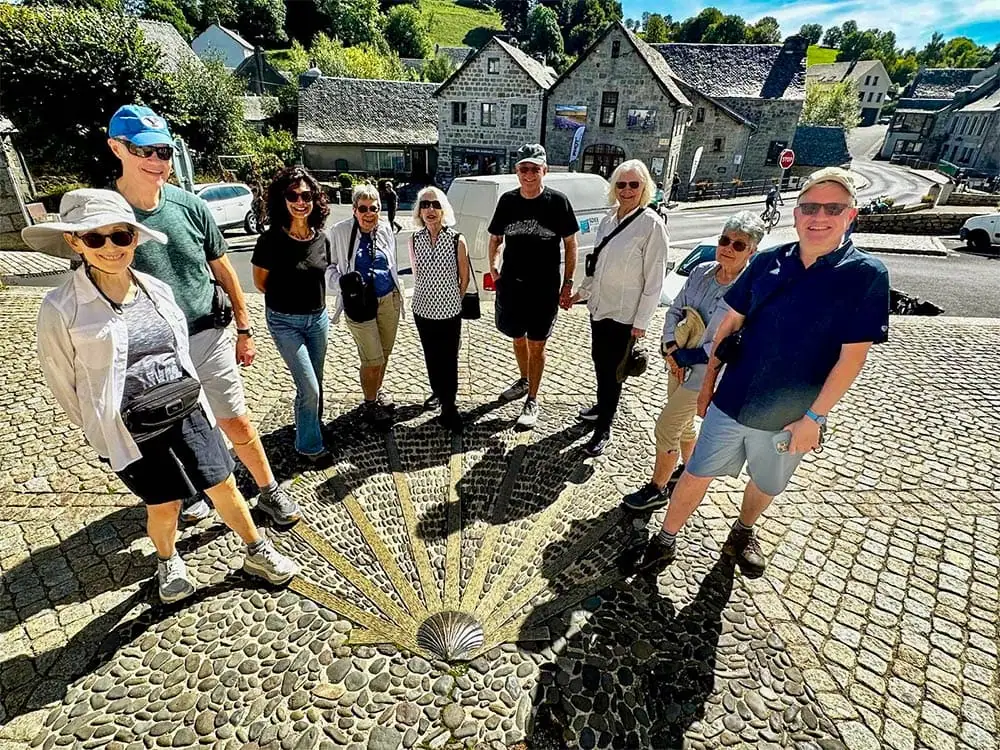
On Wilderness Travel’s Prehistoric Caves and Great Cuisine of France journey, guests travel from Bordeaux to Avignon in southern France, exploring the medieval streets of Saint-Émilion, the prehistoric caves of Les Eyzies, the serene Lot Valley, and the Ardeche Gorge. Along the way, they savor unforgettable meals in Michelin-starred restaurants, stop at the markets of Sarlat, and meet local artisans during wine and cheese tastings. This trip is an experience for the senses and one of our adventurers shares about their time here in the fall of 2025.
Several days before my departure to France in September 2025, my Chinese restaurant fortune cookie read, “Take a vacation, you will have unexpected gains.” Of course, I expected to gain some weight after enjoying delicious meals on Wilderness Travel’s Prehistoric Caves and Great Cuisine of France journey, one of their guided trips to France. But what I didn’t expect to gain was a newfound fascination with prehistoric cave drawings, a fondness for the medieval charm of the villages and towns we visited, a love for the beauty and vastness of France’s countryside, and a craving for the cheesy potato dish aligot.
A Day-by-Day Guide to WT’s History & Culinary Trip Across Southern France
Below is just a taste of what this journey is like and gives you a sense of the wonderful explorations (and meals!) you’ll enjoy.
Day 1
I met my nine fellow travelers, trip leader extraordinaire Annie Hawkins, and driver Jean-Denis in Bordeaux before our drive to Saint-Émilion, a medieval town and UNESCO World Heritage Site.


We walked through vineyards (sampling the delicious grapes that extended beyond the fence) to the Brunet Gate, built in the 12th century.


Following a walk through the town, we toured the monolithic church which was dug underground in a hillside, ate a picnic lunch where Annie walked us through our route for the trip, admired the collegiate church and cloister, and attended a tour and wine tasting at Château Guadet. We ended the day with an incredible dinner at Logis de la Cadène, a Michelin-starred restaurant.

Day 2
We began with a walk through the town of Montignac, browsing the local market stands before stopping for lunch. After lunch we continued on, passing a 15th century château and scenic countryside, to Lascaux II, an exact replica of two main halls in the Lascaux cave which was closed to the public in 1963.


The original cave of Lascaux, which was discovered in 1940 by four boys, is covered with over 600 wall paintings and 1,400 engravings of large animals including bison, horses, deer, and aurochs. The cave art dates from 17,000 to 15,000 BC. I was amazed at how the artists almost always depicted the side view of the animals and used the edges and curves of the walls to enhance their work. Note: you cannot take photos in the caves. That evening, we ate dinner at Le 1862, a Michelin-starred restaurant in our hotel in Les Eyzies.

Day 3
A walk through the village of Les Eyzies brought us to the National Museum of Prehistory. Along the way, with the river Vézère on one side and an overhanging cliff on the other, we passed the location where the Cro-Magnon man was found.

Our museum tour was led by Dr. Christine Desdemaines-Hugon, an archaeologist, author, and eminent scholar of Paleolithic anthropology. The museum was filled with exhibits of prehistoric tools, skeletons, rock carvings and etchings, and other artifacts. In the afternoon, we had a choice to go to one of two caves: Les Combarelles cave (a UNESCO World Heritage Site) with a state guide or the private Bernifal Cave with Christine. I chose the Bernifal Cave as I didn’t want to pass up the opportunity to hear more from Christine. The cave featured engravings and paintings, primarily of mammoths. It surprisingly also included a drawn human face!
We ended the day back at Le 1862 for another delicious dinner.

Day 4
For our final full day in Les Eyzies, we visited two caves—Rouffignac and Font-de-Gaume.

There are 224 animal engravings and black drawings in Rouffignac, 70% of them mammoths. The paintings are an estimated 13,000-15,000 years old, and the cave comprises more than five miles of underground passageways, a portion of which can be viewed by visitors via an electric train. Font-de-Gaume is one of the finest Paleolithic caves still open to the public, and comprises more than 200 polychrome cave drawings and engravings, including depictions of more than 80 bison, 40 horses, and 20 mammoths. Both caves were stunning and incredibly fascinating.
Dinner was on our own tonight, with recommendations provided by Annie. I opted for a creperie across the street from our hotel.
Day 5
This morning we departed for Sarlat which has some of the best preserved medieval buildings in all of France.


It was market day so we had the opportunity to see and sample local produce, meats, breads, and jams —delicious!


In the afternoon we hiked to La Roque Gageac, a beautiful village on the bank of the Dordogne River and backed by a cliff. We then visited Château de Beynac, the best preserved medieval castle beside the Dordogne River. Dinner in Sarlat was on our own.

Day 6
This morning we drove to the Lot Valley and had a private tour of the Cougnac Caves, comprising two caves, one of which was filled with stalactites and stalagmites. The second cave, similar to the first cave in terms of concretions, had amazing black and red drawings of animals and human hands. This prehistoric art is estimated to be from 25,000 to 30,000 years old.

We then checked in and had lunch at our next accommodation, Château de la Treyne, a 14th century château overlooking the Dordogne River. We walked around the grounds and private forests, enjoying the view of the river, the smell of the rose garden, and the shape of the topiaries.

We enjoyed relaxing as well as exploring the common rooms in the château before our dinner at their Michelin-starred restaurant.


Day 7
We spent the morning walking along the waters of the Ouysse River, following the pilgrimage path to the clifftop village of Rocamadour. After lunch, we explored the picturesque village, Notre Dame Sanctuary, Cathedral Saint-Sauveur, and stations of the cross.


Day 8
We drove to the Aubrac plateau in Massif Central and walked through charming hamlets, passing a waterfall, vineyards, cows, and beautiful countryside.


Following lunch, we drove to Laguiole, a town known for crafting handmade knives since the 19th century and visited a workshop to see how these beautiful knives are created.
Day 9
We spent the morning walking on the vast Aubrac plateau. As we were on the pilgrim path, we passed hikers on their way to Santiago de Compostela. We stopped for what Annie called “a light, simple lunch” in anticipation of tonight’s gourmet dinner. A meat and cheese plate, grilled sausage, a beautiful salad…and aligot!

Aligot, seen above being served by our driver, Jean-Denis, is a local dish made from a mild cheese blended into mashed potatoes with crème fraiche and butter. Despite the elasticity, it melts in your mouth. And if you want seconds (or thirds), the cook reheats the bowl.

We continued our exploration of the quaint villages, stopping at the Eglise Sainte Marie church in Naspinals before visiting the village of Aubrac and its church of Notre-Dame-des-Pouvres, dating from the end of the 12th century. We drove to our modern hotel, Bras, which had private terraces with spectacular views of the Aubrac plateau.

Dinner was at the renowned hotel restaurant, Le Suquet, where we met the chef, Sebastien Bras, prior to our epic 8-course dinner.
Day 10
Today we headed out to Vallon-Pont-d’Arc through the mountain range of the Massif Central. We stopped for lunch (pizza and salad!) in Bagnols-les-Bains. We then hiked along the Lot River to the village of Saint-Julien-du-Tournel, stopping at the Eglise Saint-Julien church.


We visited the village of Les Vans for a drink and ice cream before checking into our hotel in Barjac, where we had dinner.
Day 11
We visited our sixth and final cave—this time a private tour of the Chauvet du Pont-d’Arc, a replica of the nearby Chauvet cave which is closed to the public. The Chauvet cave has drawings dating back some 36,000 years. Following lunch, we drove to the Ardeche Gorge and walked to the natural arch.


We took a walk around the town of Barjac before returning to our hotel for our final dinner together.

Day 12
On our final morning, we drove to Avignon, where we said “Au Revoir” to Annie, Jean-Denis, and our fellow travelers who were either staying in Avignon or traveling by train to Paris. I had such good fortune to be on this wonderful and memorable adventure with Wilderness Travel. I suppose my fortune cookie was right all along.


February 4, 2026


June 27, 2025