

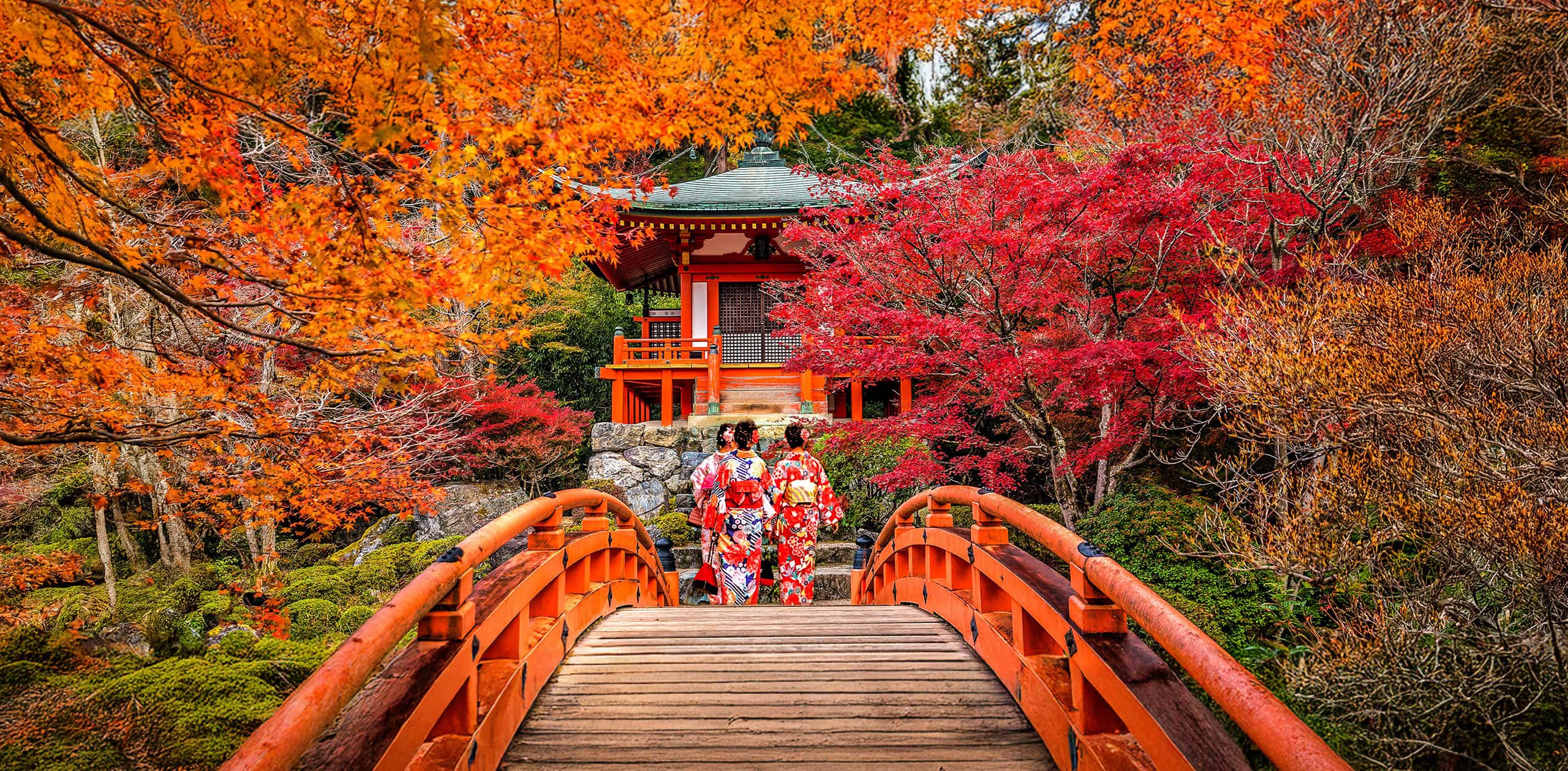
Our special journey reveals fascinating “insider” aspects of Japanese culture that travelers might not find on their own. We begin in Matsue on the northwest coast, exploring the city’s 400-year-old feudal castle and the elegant samurai houses encircling it. In the hidden gem of Kinosaki Onsen, a traditional hot springs town filled with the culture of old Japan, we soak in classic hot springs and savor fresh-caught seafood. We’ll walk the storied lanes of Kyoto, seeking off-the-beaten-path temples and gardens, with a grand finale in Takayama in the Japanese Alps, where we’ll join in the fun of a seasonal festival, celebrating the arrival of cherry blossoms in spring and the colorful fall foliage in autumn. Artisan visits, onsen baths, culinary treats, and the warm hospitality of the Japanese welcome us at every turn.


Arrive: Osaka, Japan
Depart: Osaka, Japan


In the city of Matsue, nestled between the Sea of Japan and Lake Shinji, we walk the labyrinthine paths of its majestic feudal castle, one of Japan's national treasures, completed in 1611. The samurai district and sake factory are also on our walks. At the celebrated Adachi Museum of Art, we explore its spectacular and immaculately maintained garden, designed as a “living painting.”
Scroll through our signature accommodations for this trip below. Although it is highly unlikely, we may make substitutions when necessary.


The trip is rated Level 2, Easy to Moderate, according to our trip grading system. This adventure trip features lovely walks in cities and villages.
We make the most of our time in Japan. After rising and eating breakfast, we leave our ryokan for a walking tour. Daily mini-lectures by our Trip Leader help provide insights into the past and future, the history, politics, geography, and the food of Japan. On some days, we visit temples and shrines, and other days, we follow the pathways of the shoguns or visit sites of breathtaking natural beauty. We ride the subways and buses, but we do most of our sightseeing on foot.
Although not physically demanding, the trip will yield greater rewards if you are in good physical condition and able to stay on your feet for 6-7 hours per day. In Kyoto, there is much to see, and a fair amount of walking is necessary to take it all in—and you will find there are many steps to climb! Japan is a land of staircases and hills and you will enjoy the trip more if you are dressed comfortably and are in good physical condition. Please remember we will be sleeping on futons and eating at floor level, so it is important that you are able to sit down on and get up off the floor without much difficulty.
Japan’s climate and temperature range is similar to the East Coast of the US, with four distinct seasons. In March and April, the weather is turning spring-like and we hope to enjoy the cherry blossoms. Viewing the blossoms is somewhat of a national pastime in Japan. However, as the spring is a transitional season, we can expect some rain. Temperatures should range from the 50s to the 70sF. Fall brings similarly mild and pleasant temperatures, with highs around 70F and a slight chance of rain. In the mountains, the weather is unpredictable and we may encounter rain or snow.
Japan is a blend of the traditional and modern, and our trip encompasses this unique mixture. We will stay at traditional ryokans as well as Japanese-style hotels. The quiet world of the ryokan is a venerable cultural institution—a way to experience a simple, timeless way of life. After being warmly welcomed, we trade our street shoes for slippers. Once inside, we remove our slippers as we step onto the finely woven tatami mats covering our sleeping room floors. Our rooms are spacious and pleasant with low tables and comfortable futon mattresses with quilts and blankets. Please note that in Japan, double occupancy is often accommodated in twin rooms rather than double rooms. Additionally, at ryokans single guests may share accommodations with another guest in the group of the same gender.
Some of our rooms will have attached toilets, while others will have “down the hall” toilet facilities that are shared by all guests. In addition, some may have private Western-style showers or tubs in the rooms, while others may not. All of the ryokans have a communal ofuro (a Japanese-style bath). An ofuro is an integral part of the traditional Japanese bathing ritual, emphasizing cleansing and relaxation. Normally, a fresh cotton yukata (robe) is provided for each guest at the ryokans. These light kimonos can be worn anywhere in and around the ryokan, including the ofuro, and we often wear them to meals (make sure to wear the left side over the right). For many of our breakfasts and dinners, beautifully presented meals are served as we sit on the floor at low tables on our tatami mats.
A highlight of any visit to Japan is its superb cuisine defined by fresh ingredients and artful presentation. We will have ample opportunity to sample both familiar and new dishes. Usually the first “bite” is with our eyes, the presentation being a tantalizing array of fresh fish, beef, vegetables, tofu, miso soup and, of course, rice. We eat with chopsticks and are usually seated at low tables on the floor. At some ryokans, you may choose between a Japanese breakfast of fish, rice, miso soup, tofu, vegetables, pickled condiments and tea, or a western breakfast consisting of eggs, toast, salad, and coffee. Many places, however, offer only Japanese food.
During our stays in major cities, you will have some dinners and most lunches on your own, allowing you ample opportunity to sample the endless variety of Japanese food. For lunches, we may try an obento (box lunch) or get a bowl of udon, ramen, or soba noodles. We often eat lunch at the noodle shops, the sushi bars, and the small neighborhood lunch spots, avoiding the infamous high-priced meals of Japan. Napkins are not used except at western-style restaurants; bring your own handkerchief.
Keep in mind that Japanese food is very different from what we are used to, and with the limited availability of American foods, your food intake will be a big part of the Japanese adventure. Please note that vegetarian options are available, but limited. Strict vegetarian diets, vegan diets, or gluten reduced diets will be difficult to accommodate due to the pervasiveness of the fish-based stock dashi and the use of soy sauce and miso in Japanese cuisine. Gluten free cuisine will not be available.
In Japan, bathing is a time-honored tradition and a relaxing daily event. While staying in our ryokans, we will bathe as the Japanese do—using the ofuro system. In separate men’s and women’s sides, the custom is to wash and rinse before entering the ofuro, a large tub of hot water where we can sit back with legs extended, submerged to the neck (this trip is not for the very modest!). Early Shinto was a religion of cleanliness and purification. Ritualistic bathing began during this time and has been perfected over the centuries. Either as a divine imperative or a luxury, bathing in Japan has always been regarded as more than a hygienic chore. The ofuro is the perfect way to finish a hectic day of travel. After a relaxing bath, we gather for the evening meal.
"Exactly what I hoped for. Placed myself into the Japanese culture as much as possible."
Archibald B.
Tucson, AZ
"The trip provided an immersive experience into the culture of Japan."
Beverly F.
Stamford, CT
"The overall trip design was great. We were able to see a good variety of things in Japan, from the cherry blossoms and temples to the wonderful countryside. Kate also did a great job of making the trip a wonderful experience for the entire group."
Bob S.
Half Moon Bay, CA
"Loved all of the places we visited. Glad to have spent so much time in Kyoto, and very much enjoyed the ryokans and monastery. They really helped give insight into the Japanese culture."
Carol L.
Somerville, MA
"Kate really made us all love Japan, even those who were not really expecting to do so."
Donna V.
Paris, France
"This was a wonderful trip. We had lots of new experiences and were amazed by the beauty, history, and culture. Staying at traditional-style hotels, wearing traditional clothing, and eating Japanese meals made this an immersive experience of the best sort. We had so many special experiences, special meals, and special performances."
Ellen W.
Oakland, CA
"One of the best trip I have taken with WT (my 23rd). Well designed, loved the onsen at the ryokans, the group of travelers were a plus. I wanted to have a better understanding of the Japanese culture, cuisine, scenery, and people. And this trip came through in flying colors."
Gary S.
Oakland, CA
"The trip covers a great deal of Japan for the ‘101 Course’ and first time traveler to the country. The ryokans, especially in Kyoto were fabulous."
Jennifer B.
Washington, DC
"This trip was very interesting and a great introduction to Japan—a nice mix of urban and rural. Our days were full of interesting sights and experiences, still leaving time for us to explore on our own. We definitely gained insights into Japanese culture."
Lynne R.
New York, NY
"We couldn’t have asked for a better Trip Leader. I got the feeling she could always find new things to do if we stayed indefinitely! Domo arigato!"
Marli K.
Larkspur, CA
"Our Trip Leader was very knowledgeable and a wonderful guide. Her experience in the country as well as her proficiency in Japanese were invaluable and added greatly to our experience."
Martha G.
Cambridge, MA
"Fantastic trip, great leader, fun group of folks!"
Mary P.
Yakima, WA
"The trip exceeded expectations. I loved the small group!"
Pamela W.
Corvallis, OR
"We thought the overall itinerary was excellent and was the main reason we chose WT for this trip."
Paulette N.
Fort Collins, CO
NEW TRIP

Small Group Adventure
Japan: Hiking the Kumano Kodo to Kyoto
Japan
Level 3+
13 Days
From $10,795

Small Group Adventure
Japan: Snow Monkeys & Winter Cranes
Japan
Level 2
10 Days
From $9,595

Small Group Adventure
Treasures of Laos, Vietnam & Cambodia
Laos, Vietnam, Cambodia
Level 1+
16 Days
From $8,195

Small Group Adventure
Treasures of Sri Lanka
Sri Lanka
Level 2
13 Days
From $9,195
Our Area Specialists know every detail about our tours. They will be happy to answer any questions and help you choose the journey that’s right for you. Contact us to learn more or book your trip today!
Submit the form below to download itinerary
With more than 200 different adventures to choose from, we want to help you find the trip that’s right for you. Our Trip Level system ranks each trip in two ways: a number rating from 1 to 6 according to the activity, and general travel rigors. 1 is the easiest and 6+ the most difficult.

